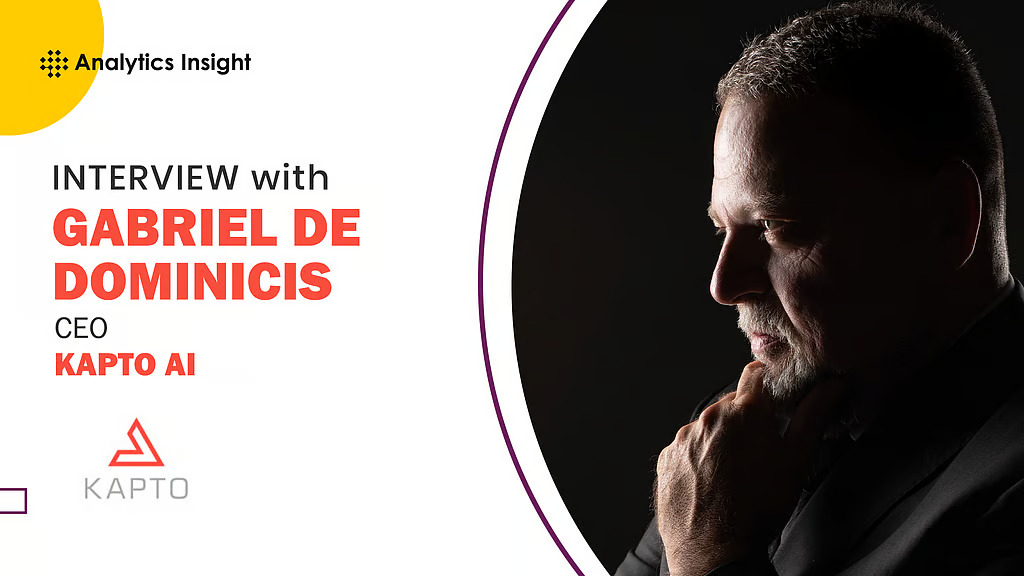
Gabriel DeDominicis, our CEO, recently sat down with Andrea Turco, Director of InsurZine, for an in-depth conversation on intelligent automation in the insurance sector. He explains how AI can evolve from a simple support function to a “digital worker” capable of managing end-to-end processes in the insurance industry, emphasizing the crucial role of change management and error risk management.
As the first online verticalized Italian newspaper in insurtech, InsurZine is the online magazine specialized in digital transformation in the insurance sector. Under Andrea Turco’s direction, InsurZine is dedicated to educating and informing insurance professionals on the issues of insurtech, aiming to accompany intermediaries on the path of digital change and become their trusted reference point.
The interview was originally conducted in Italian — we’re sharing this English version so the insights can reach a wider audience. You can also listen to the full episode on the InsurZine Podcast.
Andrea Turco: To give some context: KAPTO is an AI-based intelligent automation platform designed to automate the management and processing of corporate documents and related processes, without human intervention. Is that correct, Gabriel?
Gabriel De Dominicis: Exactly, perfectly said.
Andrea: Before diving into KAPTO, I’d like to talk a bit about you. You have a background in mathematics and completed a PhD in mathematics and computer science at the University of Passau. How has that background helped you solve typical problems in the insurance world?
Gabriel: Certainly not in a direct way - what I studied has little to do with the work I’m doing now. I actually studied and worked on completely different topics. The help is more general: it comes from the background itself. I studied and worked as a researcher more than 30 years ago.
What that experience primarily gives you is the mental ability to deal with complicated, often very complex problems. Without that kind of training, it’s not easy to break down complex problems into simpler ones, and above all, to move from a difficult general issue to many simpler, interconnected problems, where progress on one helps you solve the overall picture. In that sense, studying mathematics has definitely helped a lot.
Andrea: How did the idea for KAPTO come about?
Gabriel: The idea was born around six or seven years ago, essentially after observing the technological advancements taking place in 2017-2018 in artificial intelligence applied to text understanding. Toward the end of the last decade, it became clear to me that these advancements - at the time still mostly scientific - would completely change how companies approach document content management and information extraction. Having understood this, I decided to launch KAPTO. I’m one of the co-founders, together with others.
Andrea: On your website, you talk about “Digital Workers”, not Co-Pilots. What really changes in the daily operations of an insurance company when you move from an assistant to a system that takes over an end-to-end process like claims management? And what concrete example of value can you provide?
Gabriel: Let me use the analogy of autonomous driving.
There are different levels: from level 1 - hands on the wheel, eyes on the road, brainfully engaged - to level 5, where the car drives itself, and your brain is only engaged if the car asks for help.
In AI terms, a Co-Pilot is essentially level 1. It helps you keep the car straight and provides useful information, but you’re still driving. The higher level - autonomous AI-driven processes - is like a self-driving car. It may involve a human if it’s uncertain or unable to proceed, but otherwise it operates independently.
For example, an AI Co-Pilot may extract from a claim request information such as license plates, people involved, tax codes. That’s useful, but it’s still just extracting information and handing it to an operator.
If we want to decide whether to open a new claim, attach a document to an existing claim, or associate it with an existing damage position, we need deeper understanding. We must determine: Who is the claimant? Who is the insured party? Are they different? Is there a legal representative - a lawyer or a claims company? That changes entire processes and deadlines. Is the damaged vehicle explicitly or implicitly identifiable? Can we invoke statute of limitations or suspension terms?
All this information is needed for full automation. Once we have it, by interacting with the company’s portfolio and claims systems, we can determine the best action to take - whether to request more data, open a claim, or take another action.
A Co-Pilot extracts information. KAPTO extracts it, understands the relationships, maps them, and interfaces with company systems to autonomously decide what to do. If it’s not sufficiently confident, it involves a human. That’s the deep difference between a Co-Pilot and AI-driven automation.
Curious to see how KAPTO applies this in practice for insurers? Explore the KAPTO Insurance Solutions →
Andrea: AI has been widely discussed in the last two years. What’s the difference between using AI to support a single process step versus using it to automate an entire flow like claims or underwriting?
Gabriel: You’re touching on a major issue. There are many AI experiments today, and research - including from MIT - shows it’s often difficult to connect them to real impact.
A single AI model or interaction doesn’t shift the needle from assistance to automation.
What truly makes the difference is adopting an AI platform, not just creating AI models. Models will eventually become commodities, and specialists will always build them better than insurance companies themselves. To go into production and create impact, you need a clear understanding of the process and how to integrate AI into it. You need a platform that governs AI within the process.
That’s something new, and it will take time for companies - especially insurers - to fully understand it. KAPTO offers not only AI-driven automation and models, but also the robotic process layer that ties it all together.
Andrea: Let’s close with a practical question: what’s the most important lesson you’ve learned when an AI project moved from proof of concept to daily use in a company?
Gabriel: The most important lesson is that technology is only one aspect, and maybe not even the most decisive one. Without AI and technology, there’s no AI-driven project. But other dimensions are just as important, if not more.
The first is change management. Using AI as a tool without changing the process approach yields no real results. It becomes a fancy, possibly expensive add-on. You must redesign processes considering AI as one of the actors - on par with humans. That’s where real value comes from.
The second point is accepting that AI makes mistakes, just like humans. We accept human mistakes, but we are much less tolerant of AI mistakes, even though AI may make fewer errors in some cases. When AI makes an error, we tend to be more outraged than when a human does.
The key to mitigating this is managing the cost of error. If you fully understand your AI model, you can determine how often different types of errors occur and associate a cost with each one. The cost may be lost automation - the machine could have done it but didn’t - or actual financial, reputational, or other damage. Understanding this risk-cost matrix is essential for moving from proof of concept to production: it allows you to estimate risks and weigh them against benefits quantitatively, not just qualitatively.
Andrea: Perhaps we should also empower people in the use of AI. If AI makes a mistake, a human must intervene - it can’t correct itself entirely on its own. Correct?
Gabriel: Absolutely. At the end of the day, it’s an intelligent tool, but still a tool. Perhaps we sometimes forget that AI is a tool, not another being trying to replace us. It can improve our work rather than take it away.
This blog post is based on Gabriel De Dominicis’ interview on the InsurZine Podcast. Listen to the episode in Italian:
Want to learn more about how KAPTO automates insurance processes end-to-end?